
Chiller (Water-cooling machine) – a device for cooling liquid using a vapor-compression or absorption refrigeration cycle.

Equipment After cooling in the chiller, the liquid can be supplied to heat exchangers to cool air or various process masses in food production, or to remove heat from equipment.
The chiller circuit always includes such basic elements as a compressor, evaporator, condenser and expansion device.
The principle of operation of the system is based on the absorption and release of thermal energy due to a change in the state of aggregation of the refrigerant depending on the pressure acting on it.
In order to choose the right chiller, you should always contact specialists who have a good idea of what kind of design scheme to offer for each specific case, because despite the general principle of operation, each element of the installation plays a very important role in the functionality of the system as a whole.or mixing various components.
Cooling tunnels
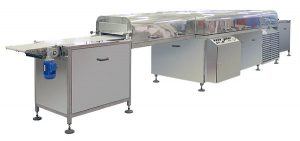

The cooling (refrigeration) tunnel is popular in the food industry and ensures the best product quality. Serves for cooling/after-cooling of the product, as well as for its transportation according to the technological chain of production of high-quality products while maintaining
the set temperature.
Purpose:
cooling and hardening of chocolate or other glaze on confectionery and semi-finished products (sweets, marshmallows, marmalade, biscuits, cookies, waffles), as well as shock freezing of fruits, vegetables, berries, meatballs, dumplings and other semi-finished products.
How it works:
The products enter the conveyor belt, after which they are transferred to the cooling tunnel, where they are cooled in a closed space by circulating cold air. Passing through the tunnel, the products are cooled to a predetermined temperature. Further, the finished products are taken out by the conveyor belt from the working area of the tunnel and leave the belt.
The cooling tunnel consists of tunnel-type cooling sections, includes a welded frame made of stainless steel. steel on which air coolers are mounted. The number of sections depends on the required cooling capacity and cooling capacity, as well as on the required length.
Conveyor belt width 400, 600, 800, 1000 and 1200 mm.
The conveyor is equipped with a drive and tension station, a drive with a motor-reducer.
The conveyor belt is blue or white.
The control panel has a frequency converter. The START, STOP buttons and the conveyor speed control button allow the operator to easily control the process.
The temperature inside the cooling conveyor is regulated and controlled by the control unit, it is possible to regulate the temperature and operating parameters in each section separately.
As an insulating material, sandwich panels are used, which have reliable thermal insulation and high strength.
The refrigeration unit can be equipped with compressors from well-known world manufacturers such as FRASCOLD, BIZER, DORIN, BOCK, COPELAND. It is possible to install the unit both in the workshop and on the street. The air condenser is located outdoors, which
allows you to lower temperature indoors.
Spiral conveyor refrigerators and freezers.
Spiral freezers are a type of conveyor refrigeration and freezing equipment in which a long continuous conveyor belt is arranged in a spiral in tiers (up to 50 tiers in height). The mesh belt with the product, sliding along the guides, moves in a spiral along a rotating drum, which drives it due to friction. Spiral freezers are compact, occupying less than 60% of the area of tunnel freezers of the same capacity.


Purpose:
Spiral conveyor refrigerators and freezers are used for cooling and shock freezing (up to -42 ° C) packaged and unpackaged products, especially culinary semi-finished products, glazed raw materials, etc. as part of large production and technological lines.
This type of freezing significantly extends the shelf life of products.
The air in this type of refrigeration equipment can circulate both horizontally and vertically.
Adjusting the speed of the conveyor and the air flow allows you to set the optimal mode of cooling-freezing for each individual type of product.
A special washing device for the tape, taken out of the thermally insulated circuit, serves to maintain the proper sanitary level.
The main disadvantages are the complexity of the design and maintenance of refrigeration equipment, as well as the presence of restrictions on the type and shape of the product to remove excess heat from the production room.